
Palestine: Resources for Islamic Schools
ISLA would like to highlight some resources that Islamic school leaders and teachers can use in their effort to help students and staff process and learn more about Palestine and its historical and religious significance.
Curricular Resources
There are so many curricular resources that are being curated and created regarding Palestine. What we are presenting here is not by any means comprehensive. Rather it is a simplified assortment of resources to make it easier for Islamic school educators to do “some”thing, i.e. “any”thing, in this moment, without being bogged down with having to read 20 different books or lesson plans.
Yet, in the long-term, we believe teachers and schools need to invest time and money in “Curriculum renewal” in Islamic schools. (Read this book for more on “curriculum renewal” and learn what it is and why it is so urgently needed). Such efforts will ensure that the books and lesson plans are scaffolded into a scope and sequence and overall curriculum that builds on “big ideas” in Islamic education, while also aligning it with state standards.
However, we cannot ignore the need to educate our students about Palestine right now if it is not already part of our curriculum. Below, find some resources we would recommend to Islamic school educators. More extensive resources can be found in curated lists such as this, compiled by Eram Uddin.
Elementary:
- Age 4-11 (Grades PreK-5): Learning Roots has a free 30-page activity book filled with excellent information and activities for young learners. The activity book focuses moreso on the religious significance of Palestine and Al-Aqsa, including stories about Musa, Maryam and Prophet Muhammad’s Isra’ wal Miraj. It also includes a map of Palestine with important cities and places. Scroll down on the linked page to find the “Al-Aqsa & The Land of the Prophets” workbook.
- Age 8+ (Grade 2-5): Talented author, Zanib Mian, has published and is offering a book for free download: “Eliyas Explains What’s Going on in Palestine“. It was written in October 2023 and explains Palestine’s historical significance from the time of the Prophets to what is happening now. It introduces key vocabulary words like “occupation”
- List of Children’s books about Palestine non-fiction + fiction, with book summaries (@Eram Uddin)
Middle/High School:
- Middle & High School: Re: Politics.
- Jewish Voice for Peace’s 6-minute video explanation about the history of the Palestine/Israel ‘conflict’ (uploaded November 2012): Mentions the oppression Jews faced before the creation of Palestine, the displacement of Palestinians to create Israel and the premise upon which Israel was created.
- This 13-minute video by John Green published in 2015, Green discusses the history of Israel and Palestine, highlighting that the differences are not related to religion, rather they are political. He starts his discussion in the late 19th century (with the Ottoman Empire) and frames the issue around the concept of “competing nationalisms,” introduces the vocabulary of “Zionism,” talks about the Balfour Declaration, and describes how the population of Muslims v Jews in Palestine/Israel shifted over time.
- Middle & High School: Re: Religious Virtues.
- The Virtues of the Sacred Land of the Masjid al-Aqsa Compound and What Surrounds It. This free e-book includes several ahadith about the virtues of Al-Aqsa. It is simple and easy to read and lends itself to a primer on some of the many virtues of this area; discussions could easily be facilitated using the Hadith as a prompt.
- High School: Re: Politics, Society & Economics.
- Visualizing Palestine is filled with powerful infographics and videos which quite literally illustrate the current and past social, economic and political issues facing Palestinians today. There is a useful search/filter system for “Language” “Theme” and “Type” on the top of the homepage to allow you to find the kinds of issues you are seeking to teach about and the type of audio/visual aid you wish to use. Given how powerful the visuals on this page are, teachers should take care in previewing them fully to ensure that they are age-appropriate. Teachers should ensure for ample time for comprehension and discussion is provided.
- High School: Re: Palestine Beyond Arabs
- A Visual History of Black-Palestinian Solidarity is an article with images that shows the connection between racial justice movements in the United States, South Africa, and Palestine. It is an excellent foundation to a deeper conversation and lessons on the connection between anti-racism and anti-imperialism.
Social and Emotional Well-Being Pointers
Students and staff alike may be experiencing secondary or third-degree trauma with the ongoing aggressions. Some tips from Clinical Psychologists Dr. Iman Farajallah and Dr. Omar Reda:
Three Levels of Trauma – Dr. Iman Farajallah:
-
- First Level: Most intense is what the people in Gaza are experiencing
- Mental health illnesses have existed for the past 75-80 years in the Palestinian population
- Has been intensified since the 2014 war as it was the most brutal war that’s been faced until now, the 2023
- There is no word to describe what the people of Gaza are going through right now. Even “Genocide” does not describe
- Second Level: Those who live in diaspora and have relatives in Gaza
- It is hard for those in the diaspora but not as extreme as those in Gaza
- While each person adopts a certain way to deal with their trauma:
- Not being able to engage in daily tasks: Showering, cooking, eating
- Feeling guilty as those in diaspora are in touch with those in Gaza suffering unimaginable challenges
- Third Level: Those who are affected through media, friends, and others
- First Level: Most intense is what the people in Gaza are experiencing
Tips for Educators for their students:
-
- Try to provide a safe space for processing their feelings and anything that is confusing to them.
- We feel that Common Sense Media does a good job of outlining what educators should consider considering when discussing “shocking” or “disturbing” news in an age-appropriate manner
- Give students the floor and take a backseat (for older students) as they consider media reporting and other related aspects to this situation
- Allow students from Palestine to talk about their experiences:
- This teaches our children to be resilient and tell their stories
- Helps us reduce the emotional overload in our hearts
- Helps us avoid compassion fatigue and emotional burnout
- This teaches our children to be resilient and tell their stories
- Promote resilience by introducing and practice coping strategies together with staff and students:
- Meditation
- Drawing/artwork
- Providing space/time to discuss that artwork and tell their stories
- Collective dua
- Try to provide a safe space for processing their feelings and anything that is confusing to them.
Tips for Educators for themselves:
-
- Consider your self-care and boundaries
- Don’t have to be hooked to the tv 24/7→ will lead to burnout and fatigue and depressive thoughts about the world
- Try to get help from mental health resources that may be available for free
- Talk to friends and close circles about what you’re feeling
- Consider your self-care and boundaries
Tips for Educational Leaders:
-
- What is your relationship with Allah? As you ask Allah for justice and fairness, ask: do you practice justice and fairness in all aspects of your leadership?
- Embark on a long-term effort to de-center the Eurocentric curriculum that is inherent in our textbooks. Consider deeply what you are teaching in your schools.
“9 D’s” to remember in this situation:
-
- Double-check our intentions
- Dig deep for skills
- Do our work to get educated
- Debate/dialogue to do the education
- Despair is not an option
- Duaa
- Donation
- Don’t forget your family and small community
- Never Defeated (we live and die dignified)
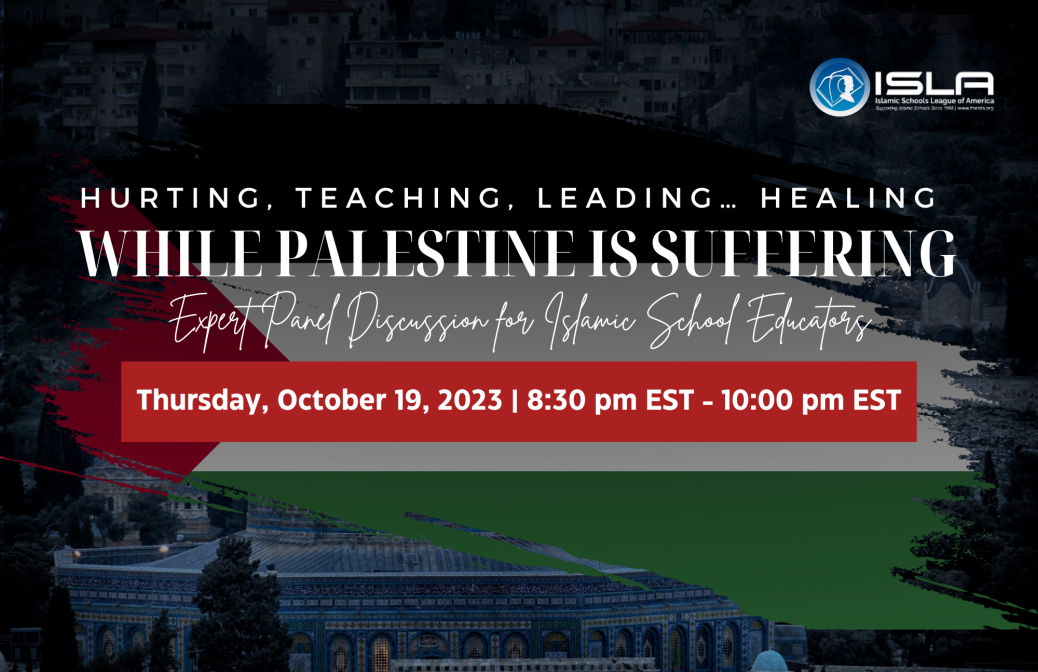
ISLA Event with Experts- October 18, 2023
The event was hosted on October 19, 2023, eleven days into Israel’s siege on Gaza. The panelists included:
The panelists’ names are hyperlinked to a document that includes notes from the online event.
